
Oct 18, 2026Bike Accessory Buying Guides
Magnetic vs. Side-Release Buckles: How to Choose for Custom Bike Bags
Choosing buckles for custom bike bags? Learn what to check—from locking action and load ratings to webbing and stitching. Send us your design for hardware recommendations before sampling.
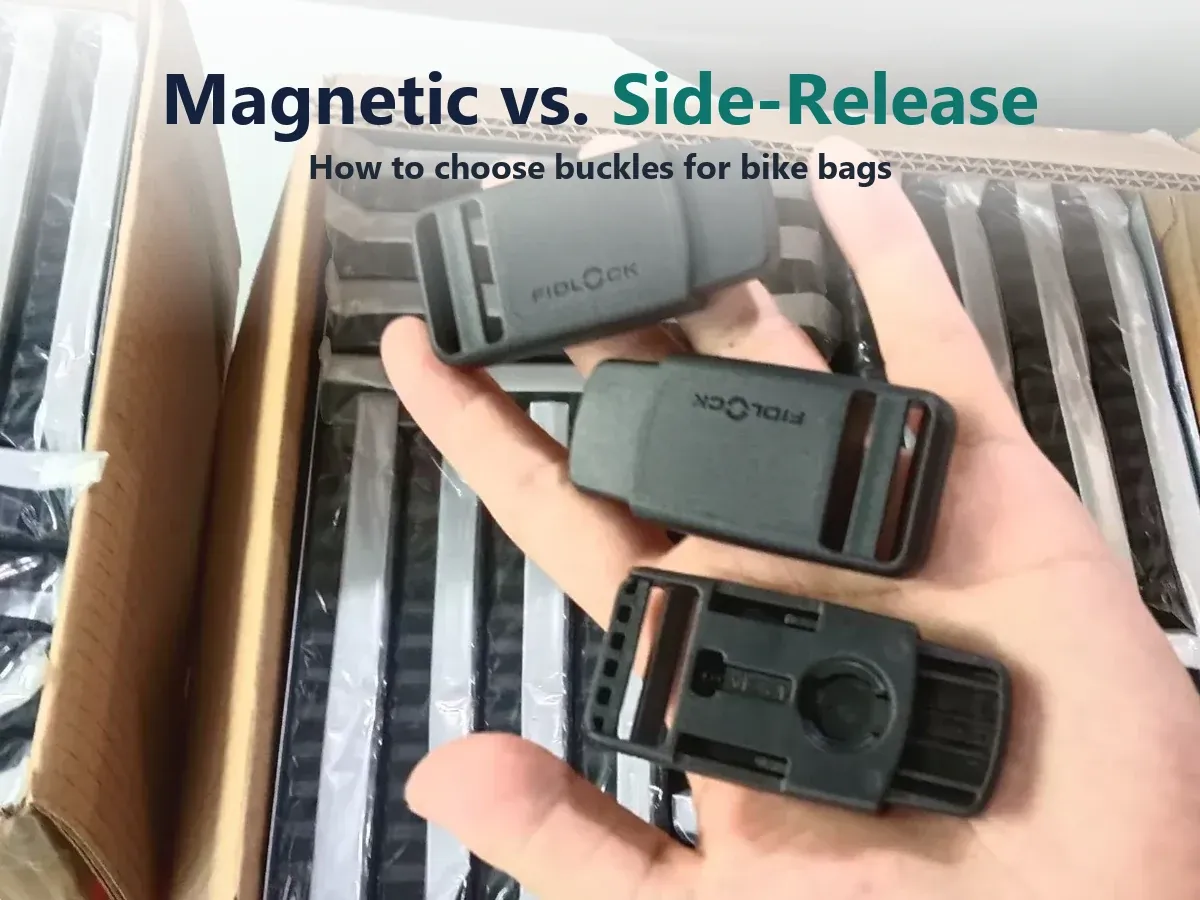
Magnetic vs. Side-Release Buckles: How to Choose for Custom Bike Bags
A buckle that looks right can still be wrong for your bag. It may slip on the webbing, be awkward to open with gloves, or put too much strain on the stitching.
For bike brands, the goal is straightforward: choose a closure that suits the way customers use the product—and works within your budget.
Here is what to check before approving your sample.
Are Magnetic Buckles Better?
Magnetic buckles can make closing a bag easier. Side-release buckles offer a familiar push-to-open action and may suit projects where cost is a priority.
Neither type is automatically stronger. Performance depends on the specific model, its locking mechanism and how it is fitted to the bag.
Compare individual models, rather than choosing by brand or the word “magnetic.”
What Does a Buckle’s Strength Rating Tell You?
A datasheet’s breaking load tells you the force at which a component fails under specified test conditions.
For example, FIDLOCK lists a 686 N breaking load for a V-BUCKLE 25 configuration. That is approximately 70 kgf of pulling force—not a 70 kg safe carrying capacity for a finished bag. www.fidlock.com
Your finished product also depends on the webbing, stitching, fabric reinforcement and direction of pull. A strong buckle cannot compensate for a weak attachment.
Ask your supplier:
- Which exact buckle model will be used?
- What does its published load figure measure?
- How will it attach to the bag?
- How will the assembled sample be checked?
Choose the Buckle Around the Job
Start with what the closure needs to do.
Application | What to check first |
|---|---|
Pocket or flap closure | Easy access and secure closing |
Roll-top bike bag | Closure tension and webbing adjustment |
Compression strap | Resistance to slipping under tension |
Bag-to-bike attachment | Retention, mounting strength and movement |
Cargo-bike rain cover | Operation with gloves and resistance to accidental opening |
A pocket closure and a strap securing a loaded bag have different requirements. They should not share a specification simply because both use 25 mm webbing.
Check the Whole Attachment
Before approving hardware, review the buckle, webbing and stitching together.
Webbing fit: Does it match the buckle’s specified width and thickness? Does the adjustment hold when tension is applied?
Attachment: Is the load spread through a suitable reinforcement area, or concentrated on a small patch of fabric?
Position: Can the rider reach the buckle easily? Could a loose strap or nearby part catch the release?
Operation: Can the user tell when it is fully locked? Is opening and closing practical with gloves?
These details are easier to change during sampling than after bulk production.
Test the Finished Sample
Component data helps you shortlist hardware. Sample evaluation helps you check whether that hardware works in your design.
Agree on checks that reflect the intended use, including:
- Opening and closing the buckle repeatedly.
- Checking webbing adjustment under tension.
- Inspecting stitching and reinforcement after loading.
- Checking retention during representative riding conditions.
- Reviewing operation after exposure to expected wet or dirty conditions.
Opening cycles, vibration tests and static pull tests measure different things. Specify the test method and acceptance criteria instead of asking only for a “heavy-duty buckle.”
Keep Cost in the Decision
The most expensive buckle is not automatically the best choice for every position.
A frequently used main closure may justify a different component from an internal pocket. Selecting hardware by function helps you put the budget where the rider will notice it.
Before sampling, confirm the exact model, finish, availability and any proposed alternatives. Include the approved hardware in the production specification.
Developing a Custom Bike Bag?
YAGOO BAG develops custom bike bags, rain covers and fabric accessories for e-bike and cargo-bike brands. We can review buckle options alongside the webbing, attachment points and sewing construction.
Depending on your design and budget, options can include FIDLOCK, Duraflex and other specified components.
Send us a photo or drawing of your bag and tell us what it needs to carry. We’ll help you narrow down the hardware and attachment options before sampling.
Custom development starts from 300 pieces, with samples typically ready in 7–12 days, subject to materials and project requirements.